

The UK Desk: Black Triangles Over British Housing Estates, and the Charlton Crater Mystery
New reports map 'black triangle' sightings across Britain, while a Sky HISTORY programme revisits the Charlton Crater case. We also delve into Project Condign, the MOD's final public UAP study.
This week, the focus for unexplained aerial phenomena in the UK falls on the persistent reports of 'black triangles' and a new programme revisiting a historical Wiltshire case. These local reports and historical curiosities continue to prompt questions about what precisely is being observed in British airspace and what official bodies have made of them in the past.
This week in Britain
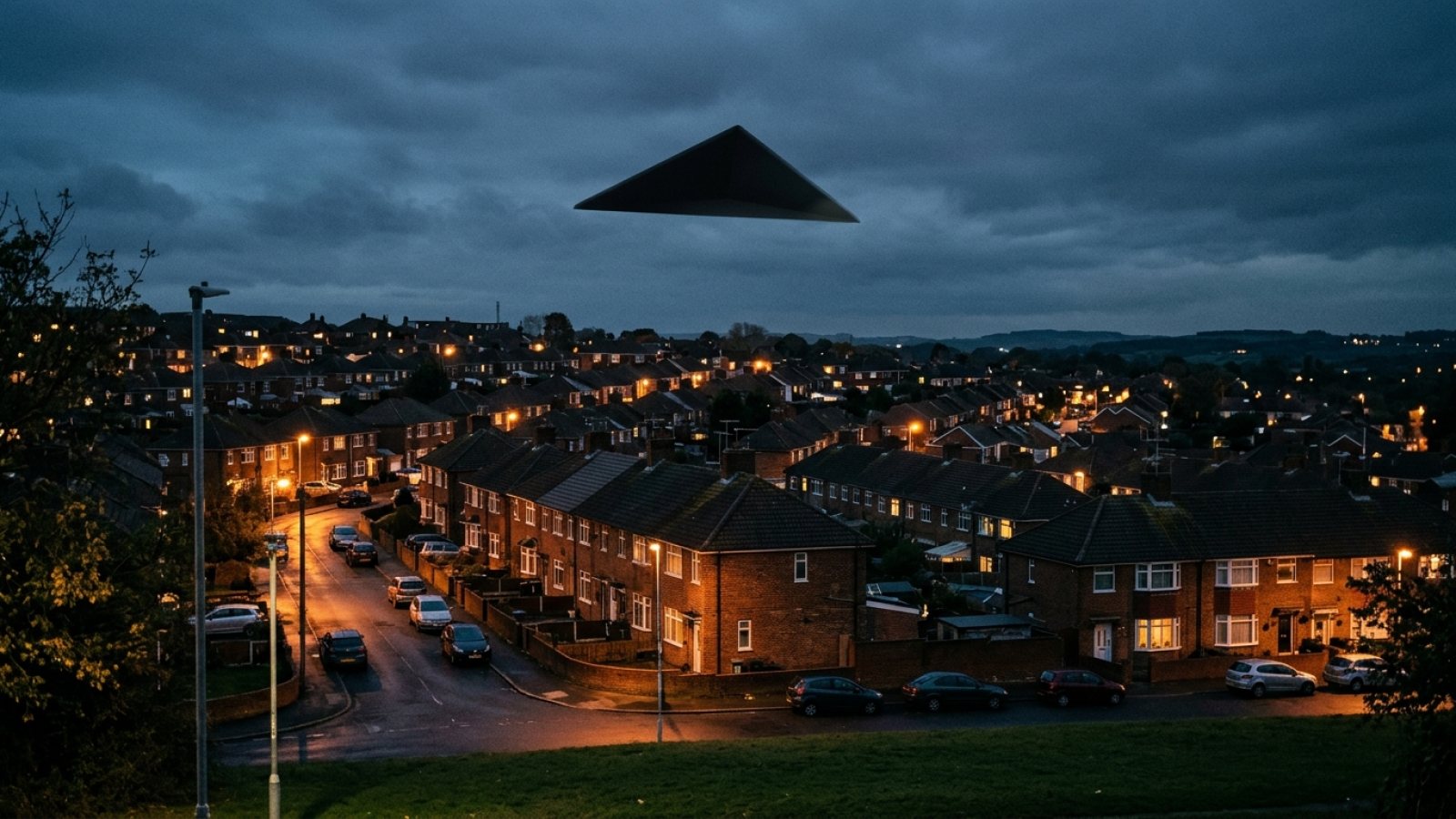
The Daily Star reported on 'black triangle' UFOs allegedly swarming British skies, seen gliding over housing estates, while Yahoo News UK also mapped UK UFO sightings, highlighting that these 'black triangles' are apparently also a concern for Pentagon officials across the Atlantic. These reports echo a pattern of dark, often silent, triangular objects described by witnesses over many years, which remain a source of ongoing discussion.
Further local reporting saw several outlets detailing regional UAP activity. The Manchester Evening News mapped sightings over Greater Manchester, describing "machines above Moston and lights over Levenshulme". Similarly, Yahoo News UK detailed every Derbyshire UFO 'sighting' in the last five years, including a "perfect triangle" above one town, and Wales Online mapped that country's UFO hotspots, noting "Tic-Tac" shaped objects and pulsating orbs.
Meanwhile, a man from Sauchie, Scotland, appeared on a BBC programme to discuss his 'UFO sightings' in central Scotland. Such appearances on mainstream media often bring local experiences to a wider audience, contributing to the ongoing public discourse around these phenomena.
On the historical front, Sky HISTORY TV channel previewed a programme asking: 'Did a UFO land in Wiltshire in 1963?' The 'Charlton Crater' case, involving a claimed impact site and unusual findings, remains a notable though disputed chapter in British UAP history. Separately, Sky HISTORY also touched on USOs: The underwater mysteries that have baffled for centuries, a topic of general interest that occasionally intersects with UAP reports.
Beyond these shores
Internationally, the Daily Mail reported on a mysterious 'UFO' spotted in NASA video, sparking claims of a near collision. Such incidents, often involving distant objects captured by official cameras, are frequently shared and discussed, though rarely result in definitive conclusions. Elsewhere, a triangular UFO was filmed near a Mexican volcano, a report also picked up by Coast to Coast AM. The appearance of triangular objects in various global locations continues to be a recurring theme in UAP observations, offering a wider context to the UK's recent reports.
From the files: Project Condign
Project Condign was the UK Ministry of Defence's intelligence assessment of Unidentified Aerial Phenomena (UAP), conducted between 1996 and 2000. It represented the final publicly acknowledged official study into UAPs undertaken by the MOD. The project's existence and findings only came to widespread public attention following a series of Freedom of Information requests in the early 2000s, leading to the declassification and release of its core report, commonly known as the 'Condign Report', to The National Archives at Kew in 2006/2007.
The study sought to determine whether UAPs posed any defence threat to the UK. It examined a wide array of sightings, witness statements, and radar data, concluding that there was no evidence to suggest hostile intent or an extraterrestrial origin for any of the phenomena observed. The report indicated that the majority of UAP sightings could be attributed to prosaic explanations, such as conventional aircraft, meteorological balloons, satellites, or unusual atmospheric conditions.
Crucially, however, Project Condign acknowledged a small percentage of genuinely unexplained aerial phenomena. The report speculated that these harder-to-explain cases, particularly those involving unusual shapes, high speeds, or erratic movements, might be attributable to novel meteorological or atmospheric plasma phenomena. It described naturally occurring, electrically charged atmospheric fields that could form coherent, self-luminous bodies, capable of appearing and disappearing suddenly and mimicking structured craft. The study stated that no defence benefit or threat had been identified from these unexplained occurrences.
The release of the Condign Report marked a significant moment in UK UAP discourse, providing a rare glimpse into the MOD's internal assessment process. While it dismissed notions of alien visitors and posed no further investigation, its acknowledgement of genuinely unexplained aerial phenomena, even if attributed to unconventional atmospheric physics, underscored that not all sightings could be readily dismissed. It remains a key document for understanding the official British posture on UAP, and why the MOD subsequently ceased dedicated UAP investigations, stating no defence interest or threat was ever established.
The UK Desk is compiled with AI assistance from public reporting. Every news item links to its source; read the original before you repeat it.
