
The UK Desk: who is listening, and what have they heard?
The search for a signal from another civilisation has a British address: Jodrell Bank in Cheshire. A look at who is listening, the famous signal that was never repeated, and the promising one that turned out to be our own.
Most of what is called ufology looks up. The search for extraterrestrial intelligence, SETI, listens. It is a quieter discipline with stricter rules, and Britain has been part of it for a long time. If a deliberate signal from another world is ever confirmed, there is a fair chance a British dish will be involved in checking it.
Jodrell Bank
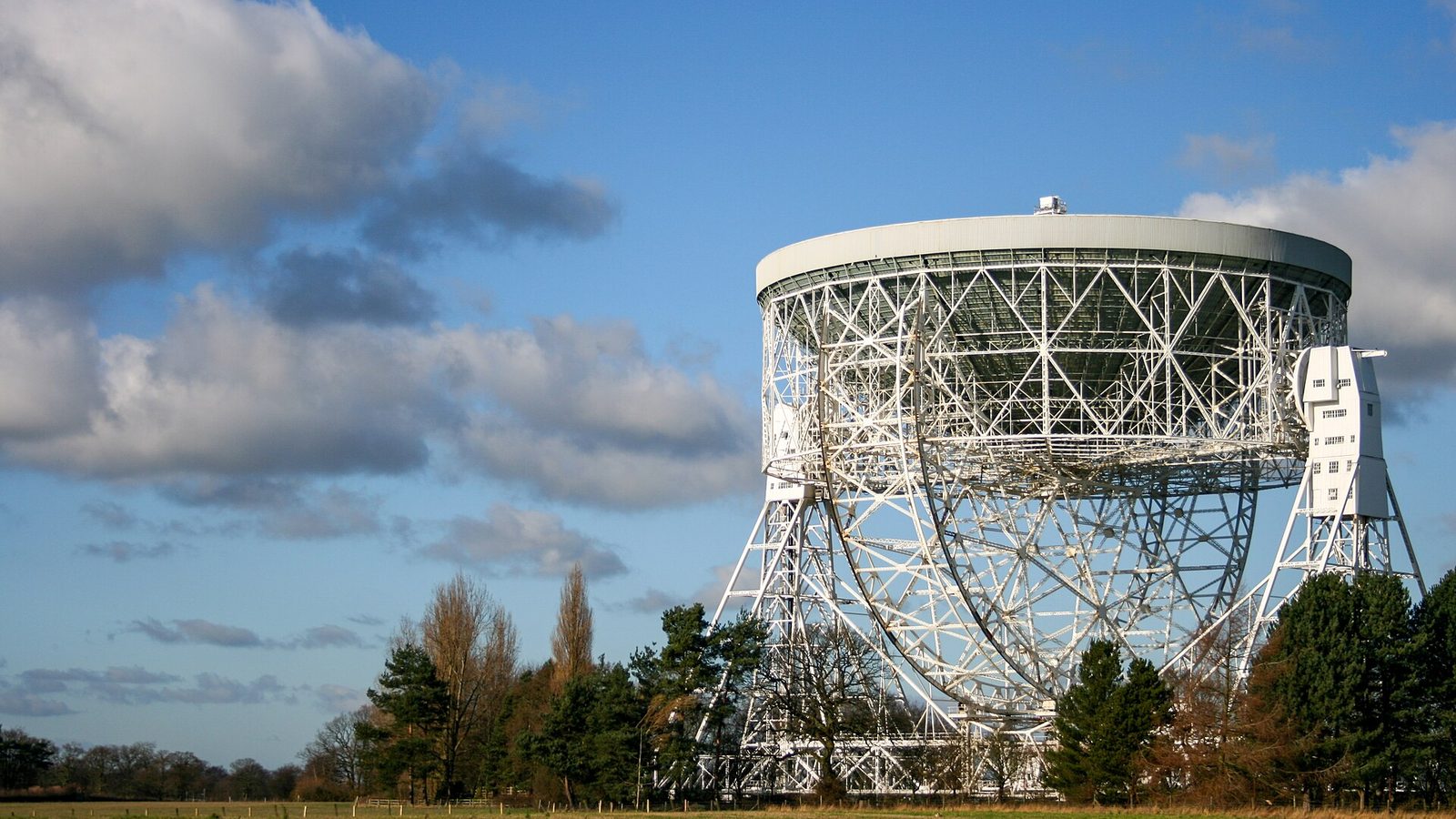
The Lovell Telescope in Cheshire, one of the largest steerable dishes in the world, took part in the SETI Institute's Project Phoenix from 1998 to 2003, searching for signals from about a thousand nearby stars (University of Manchester). In 2015 the Breakthrough Listen programme, a ten-year, privately funded search, was launched at the Royal Society in London. Jodrell Bank later signed up as a partner: the University of Manchester's team runs an independent search with the Lovell Telescope and the e-MERLIN array of dishes across England, and the two projects share observing plans, methods and data, including rapid sharing of any promising signal. The first SETI observations with the new equipment at Jodrell Bank took place in June 2019 (Breakthrough Listen, arXiv).
Jodrell Bank is also the headquarters of the Square Kilometre Array Observatory, the intergovernmental body building the largest radio telescope on Earth, with its dishes and antennas in South Africa and Western Australia (University of Manchester). Its main purpose is astronomy, not SETI, but a telescope that sensitive changes what any search can hope to hear.
The signal that was never repeated
On 15 August 1977, the Big Ear radio telescope at Ohio State University recorded a strong, narrow-band signal lasting about 72 seconds, roughly the time a fixed point in the sky took to pass through its beam. The astronomer Jerry Ehman circled it on the printout and wrote Wow! in the margin (overview). It has been searched for many times since and has never been detected again. It remains the best-known candidate in the field, precisely because it could never be checked.
The signal that was ours: BLC1
In April 2019, Breakthrough Listen observed Proxima Centauri, the nearest star to the Sun, with the Parkes telescope in Australia. The data held a narrow signal near 982 MHz that seemed to come only when the telescope pointed at the star, which is what a real signal should do. It was named BLC1, Breakthrough Listen Candidate 1, and it leaked to the press in late 2020 (Berkeley SETI).
The team's own analysis, published in Nature Astronomy in 2021, concluded that BLC1 was not from Proxima at all. It was interference from human equipment that happened to line up with the observing pattern; the team then found dozens of similar signals in observations pointed elsewhere (Sheikh et al., Nature Astronomy). The scientists said plainly that it had fooled their filters. That is the useful lesson: the process worked, slowly and in public (The Conversation).
Talking points for the show
- UFO reports and SETI ask the same question in opposite ways: one waits for something to arrive, the other listens for something sent. Why do the two camps so rarely talk?
- Wow!: is a signal that never repeats evidence of anything, or just a puzzle?
- BLC1 was ruled out by the people who found it. What would a genuine detection have to survive before anyone announced it?
- If a British dish confirmed a signal tomorrow, who would be told first, and who decides what we say back?
- Radio interference is our own noise. How much of the sky are we drowning out ourselves?
Sources
- University of Manchester, Jodrell Bank and SETI
- The Breakthrough Listen search (arXiv:1907.05519)
- SKA Observatory headquarters at Jodrell Bank
- Wow! signal (overview)
- Berkeley SETI: BLC1
- Sheikh et al., Nature Astronomy 2021 (record)
- The Conversation on BLC1
Picture: The Lovell Telescope at Jodrell Bank, Cheshire · Photo: Mike Peel; Jodrell Bank Centre for Astrophysics, Wikimedia Commons, CC BY-SA 4.0, cropped
The UK Desk is compiled with AI assistance from public reporting and published records. Every claim links to its source; read the original before you repeat it.
